






Chief Marine Officer (CMO) Resume Sample
Position Yourself Ahead of Other Candidates!
We partner with senior leaders to position them for high-impact opportunities - through a strategically crafted, ATS-optimized executive resume and by managing your entire job search end-to-end.
Book a 20-minute confidential call to speak directly with Arno Markus, former executive recruiter and President of the National Reverse Recruiter Association
Related Resume Samples:
Request a Consultation from an Award - Winning Recruiter and Resume Writer
(Board C-Level VP, Director & Mid - Career Professionals)
How to write Chief Marine Officer (CMO) Resume
When it comes to sailing the high seas, the Chief Marine Officer (CMO) is responsible for ensuring that all operations onboard run smoothly. Whether it’s overseeing shipboard operations, maintaining equipment, or managing crew members, a CMO plays a pivotal role in maritime operations. If you’re aspiring to become a Chief Marine Officer or seeking new opportunities in the field, your resume should reflect your expertise and qualifications succinctly. Here’s a comprehensive guide on how to create a compelling CMO resume.
Expert Tip: Make sure you highlight your accomplishments in a way that will appeal to the hiring manager.
This means focusing on skills that are relevant to their industry and company. Discuss your skills and abilities in each area of expertise. Include both technical skills and soft skills such as leadership, communication, and teamwork. nclude any awards or recognition that you have received for your work, as well as any other notable achievements.
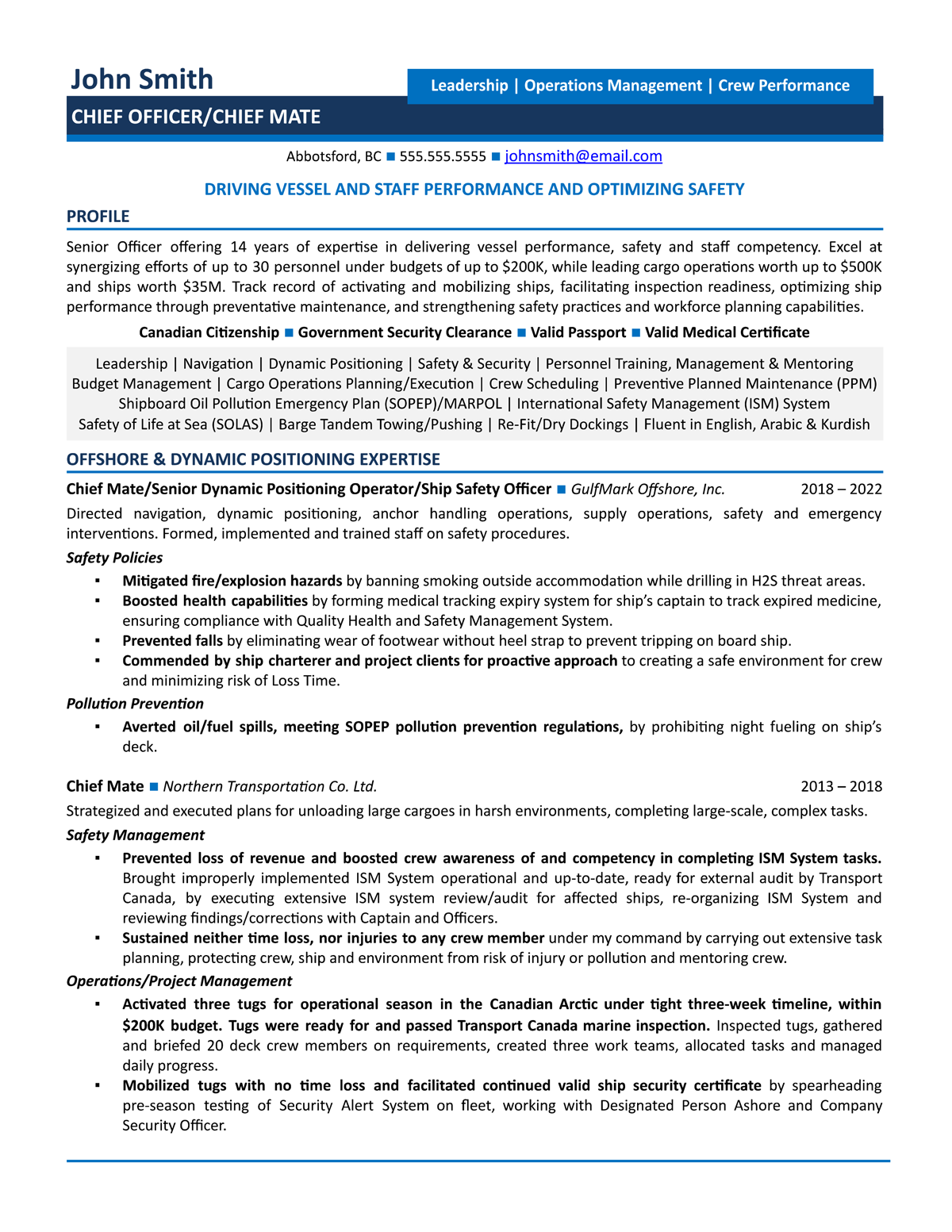
A reverse chronological format is most appropriate for a Chief Marine Officer or other position with a high number of years of experience. A reverse chronological resume includes the header with your updated contact details, professional resume summary, work experience, and additional skills and education sections. It should also include your most impressive achievements and honors. Reverse chronological resumes can help you win the approval of Reed Hastings and earn an interview.
Select the Right Resume Format
For a senior role such as the CMO, it’s vital to select a format that emphasizes experience and accomplishments. The reverse-chronological format, where you list your most recent job first, is often the best choice. It allows potential employers to see your most recent and relevant experience immediately. There are three main resume formats to consider:
- Chronological: This format lists your work experience in reverse chronological order, focusing on your career progression. It is ideal for chief marine officer with a steady career path in the same industry.
- Functional: This format emphasizes your skills and achievements rather than your work history. It can be useful for those with career gaps or transitioning to a chief marine officer role.
- Hybrid/Combination: This format combines elements of both chronological and functional formats, highlighting relevant skills and achievements while showcasing your work experience. It is suitable for Chief Marine officer with diverse backgrounds and experiences.
Powerful Summary for Chief Marine Officer (CMO) Resume
You must also include a professional career summary. The summary should focus on the specific achievements you’ve made while in each position. A Summary lists your strongest features in a job description for your prospective employer to easily recall and also provides a way to identify personal traits.
Instead of an objective, write a concise professional summary that provides a snapshot of your career. In 3-4 lines, highlight your years of experience, areas of expertise, and a couple of major achievements.
Example: “Seasoned Chief Marine Officer with over 15 years of experience in overseeing large vessel operations, crew management, and maritime safety. Successfully managed a fleet of five ships, resulting in a 20% reduction in operational costs.”
Expert Tip: Remember summary sections are brief and contain tiny fragmented sentences.
Chief Marine Officer (CMO) Resume Summary Example
Wrong
Chief Marine Officer with experience. Track record in managing multi-ship. Ability to streamline operations to increase efficiency and safety.
Right
Results-oriented Chief Marine Officer with over 15 years of maritime experience. Exceptional track record in managing multi-ship fleets and large, diverse crews. Demonstrated ability to streamline operations to increase efficiency and safety.
You should also include your accomplishments in your summary. Be clear about what you’ve accomplished—and make sure those accomplishments are quantifiable.
Showcase Your Core Competencies
The maritime industry is as old as human history and has evolved tremendously over the centuries. With advancements in technology and the increasing complexity of maritime operations, the role of a Chief Marine Officer (CMO) is now more demanding than ever before. It’s not just about steering the ship – it’s about leadership, risk management, technical expertise, and so much more. If you’re gunning for a CMO role or looking to refresh your resume, highlighting a well-rounded skill set is paramount. Here are the essential skills you should consider including on your Chief Marine Officer resume.
Include a mix of technical, managerial, and soft skills:
- Technical: Navigation, ship maintenance, safety protocols.
- Managerial: Crew management, budgeting, fleet coordination.
- Soft Skills: Leadership, communication, decision-making.
Expert Tip: By carefully reviewing the job posting and working with an executive resume writer, you can ensure that your CMO resume has the right keywords!
Why are these skills so important to have on your CEO resume?
Because of the dreaded Applicant Tracking Systems used by hiring managers and Executive Recruiters when creating the CEO job description. These ATS systems are programmed with the keywords that the hiring manager feels are most appropriate for their position. These keywords could be slightly different from the exact same job but at a different company created by a different HR manager. It is important to not only match the job title with your branding title but also to match the keywords. A professional CEO resume writer can assist you with keyword optimizing your CEO resume.
1. Technical Navigation Skills
- Advanced Ship Handling: Mastery in maneuvering ships, especially in challenging conditions.
- Electronic Navigation Systems: Proficiency in using modern tools like ECDIS, GPS, and radar systems.
- Chartwork & Traditional Navigation: The ability to use traditional tools, including sextants, compasses, and paper charts.
2. Crew Management and Leadership
- Team Leadership: Ability to motivate, lead, and manage a diverse crew.
- Conflict Resolution: Mediating conflicts among crew members to ensure smooth operations.
- Training & Development: Providing ongoing training and guidance to crew to ensure their skills remain updated.
3. Safety and Compliance
- Maritime Safety Protocols: Mastery in SOLAS (Safety of Life at Sea) conventions, fire safety, and life-saving techniques.
- Regulatory Compliance: Knowledge of international maritime laws and the ability to ensure the ship and crew adhere to these regulations.
- Emergency Response: Ability to act promptly and effectively during emergencies, such as fires, ship groundings, or medical emergencies.
4. Mechanical Aptitude
- Ship Maintenance: Familiarity with the ship’s systems, machinery, and equipment, ensuring they’re in working order.
- Troubleshooting: Ability to diagnose and resolve technical and mechanical issues onboard.
5. Financial and Operational Management
- Budgeting: Overseeing the ship’s finances, including provisions, fuel, and maintenance costs.
- Operational Efficiency: Streamlining operations to ensure that the ship’s voyages are efficient and cost-effective.
6. Communication Skills
- Clear Communication: Ability to communicate instructions, updates, and issues clearly to crew members and port authorities.
- Multicultural Communication: Given the diversity on ships, CMOs often interact with people from various cultures and backgrounds.
7. Environmental and Sustainability Awareness
- Environmental Regulations: Knowledge of MARPOL and other environmental protection regulations.
- Sustainable Practices: Implementing sustainable practices, such as waste reduction and energy conservation, aboard the ship.
8. Decision Making and Problem Solving
- Quick Decision Making: Often, CMOs need to make quick decisions in high-pressure situations.
- Analytical Thinking: Ability to assess situations, anticipate problems, and come up with solutions promptly.
9. Physical Fitness and Stamina
- Endurance: The resilience to handle the physical demands of the role, such as long hours and potentially challenging sea conditions.
- Medical Fitness: Ensuring one’s health meets the maritime industry’s regulatory standards.
10. Lifelong Learning and Adaptability
- Continuous Learning: The maritime industry is evolving. A successful CMO should be committed to ongoing training and learning.
- Adaptability: The ability to adapt to changing technologies, regulations, and crew dynamics.
Detail Your Work Experience
In the vast expanse of the maritime industry, the Chief Marine Officer (CMO) stands tall, steering the ship through unpredictable waters, both literally and figuratively. When aspiring for such a prestigious position, presenting your work experience effectively on your resume is crucial. The work experience section is the heart of a CMO resume, where one showcases a proven track record of maritime expertise and leadership.
Here how to detail your work experience to cast a favorable impression:
1. Highlight Your Leadership Roles
A CMO is first and foremost a leader. Showcase roles where you’ve led teams, supervised crew members, and made critical decisions.
Example: Chief Marine Officer, BlueWave Shipping, Singapore — 2018-2022
- Led a multi-national crew of over 100 members, ensuring smooth daily operations.
- Successfully maintained a 95% crew retention rate over four years.
2. Detail Technical Responsibilities
Beyond leadership, a CMO is expected to have deep technical expertise. Highlight your responsibilities related to navigation, machinery operation, and other technical aspects.
Example:
- Oversaw the ship’s navigation using advanced tools like ECDIS, ensuring timely voyages.
- Played a pivotal role in the preventive maintenance of ship machinery, reducing downtime by 20%.
3. Showcase Achievements, Not Just Responsibilities
While it’s essential to convey your day-to-day responsibilities, highlighting tangible achievements can set your resume apart.
Example:
- Introduced an innovative route optimization technique that reduced fuel consumption by 15%.
- Successfully managed crisis situations, including two major storms, without any damage or injuries.
4. Emphasize Safety and Compliance
Safety is paramount in maritime operations. Detail your roles in maintaining safety protocols, conducting drills, and ensuring regulatory compliance.
Example:
- Implemented rigorous safety drills, resulting in zero onboard accidents in the tenure.
- Ensured 100% compliance with international maritime regulations, including SOLAS and MARPOL.
5. Highlight Interpersonal and Coordination Roles
A ship is a microcosm of diverse individuals working in tandem. Highlight your experience in coordinating with different departments, resolving conflicts, and ensuring harmony onboard.
Example:
- Coordinated between the deck department, engine room, and galley to ensure smooth operations.
- Mediated conflicts among crew members, fostering a harmonious work environment.
6. Don’t Ignore Training and Development
If you’ve been involved in training younger crew members or introducing new onboard training protocols, it’s worth mentioning. It demonstrates your commitment to skill development and crew welfare.
Example:
- Introduced a monthly training regimen, focusing on both technical skills and soft skills like communication and teamwork.
- Mentored over 50 junior officers, with 10 of them now serving as senior officers in various vessels.
7. Proofread and Use Action Words
Your resume should be free from errors. Use action verbs like ‘led,’ ‘managed,’ ‘implemented,’ and ‘achieved’ to make your experience stand out.
Highlight Your Education and Professional Development
For the CMO role, maritime education and certifications are crucial. List your maritime academy degree, any advanced degrees, and relevant courses or certifications.
Example:
- Bachelor’s in Maritime Operations, XYZ Maritime Academy, 2008.
- Advanced Nautical Leadership Course, Sea Training Institute, 2012.
Given the technical nature of marine operations, certain certifications might be essential or beneficial for the role:
- Master Mariner’s License
- STCW (Standards of Training, Certification and Watchkeeping) Certificate
- Advanced Firefighting Training
- Medical First Aid On Board Ship Training
Being a part of professional bodies such as the International Maritime Organization or national maritime associations can showcase your commitment to the industry. List memberships and any significant roles you’ve held within these organizations.