

Add first resume sample heading here
Add first resume sample paragraph here
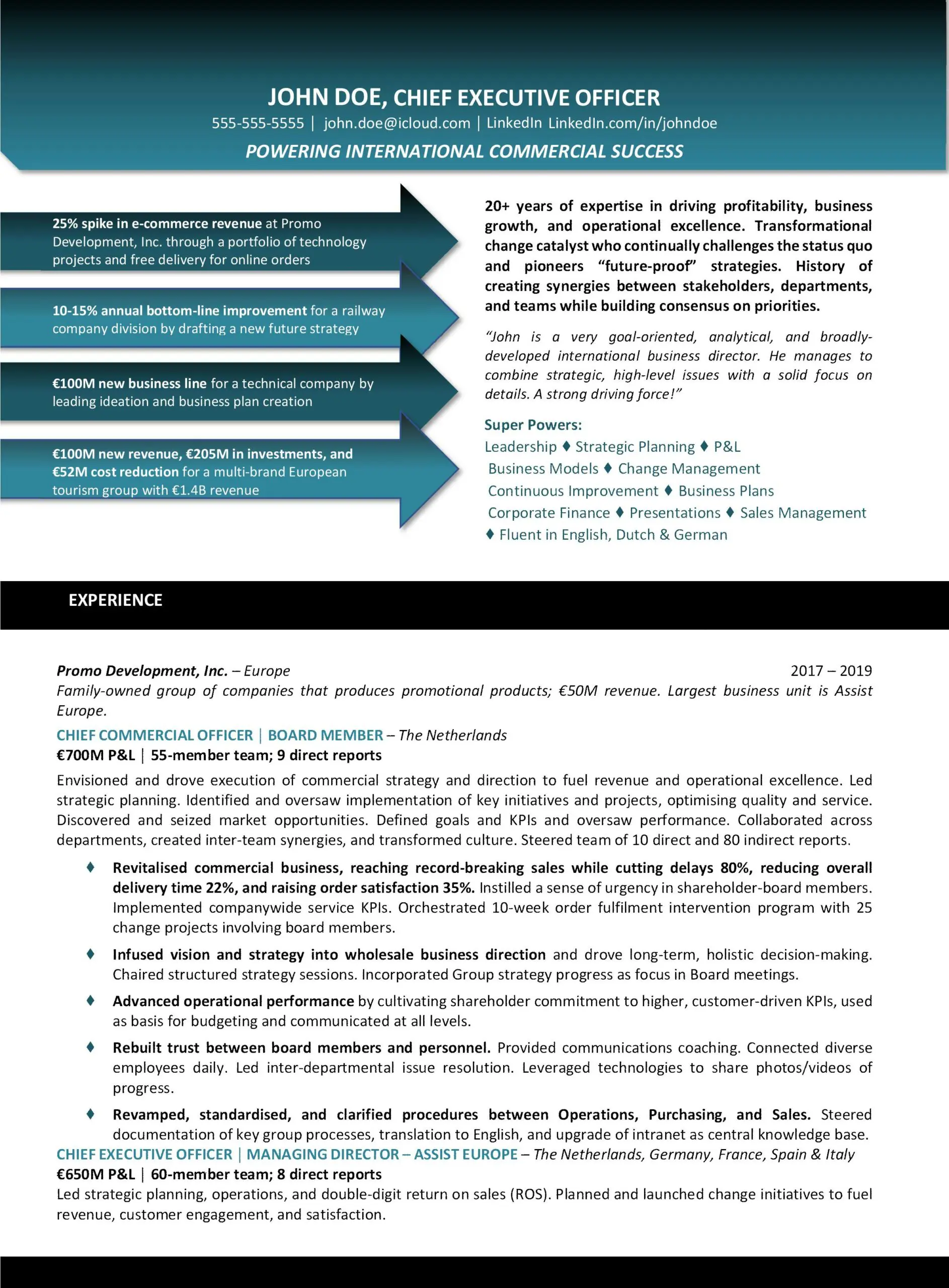

Add second resume sample heading here
Add second resume sample paragraph here
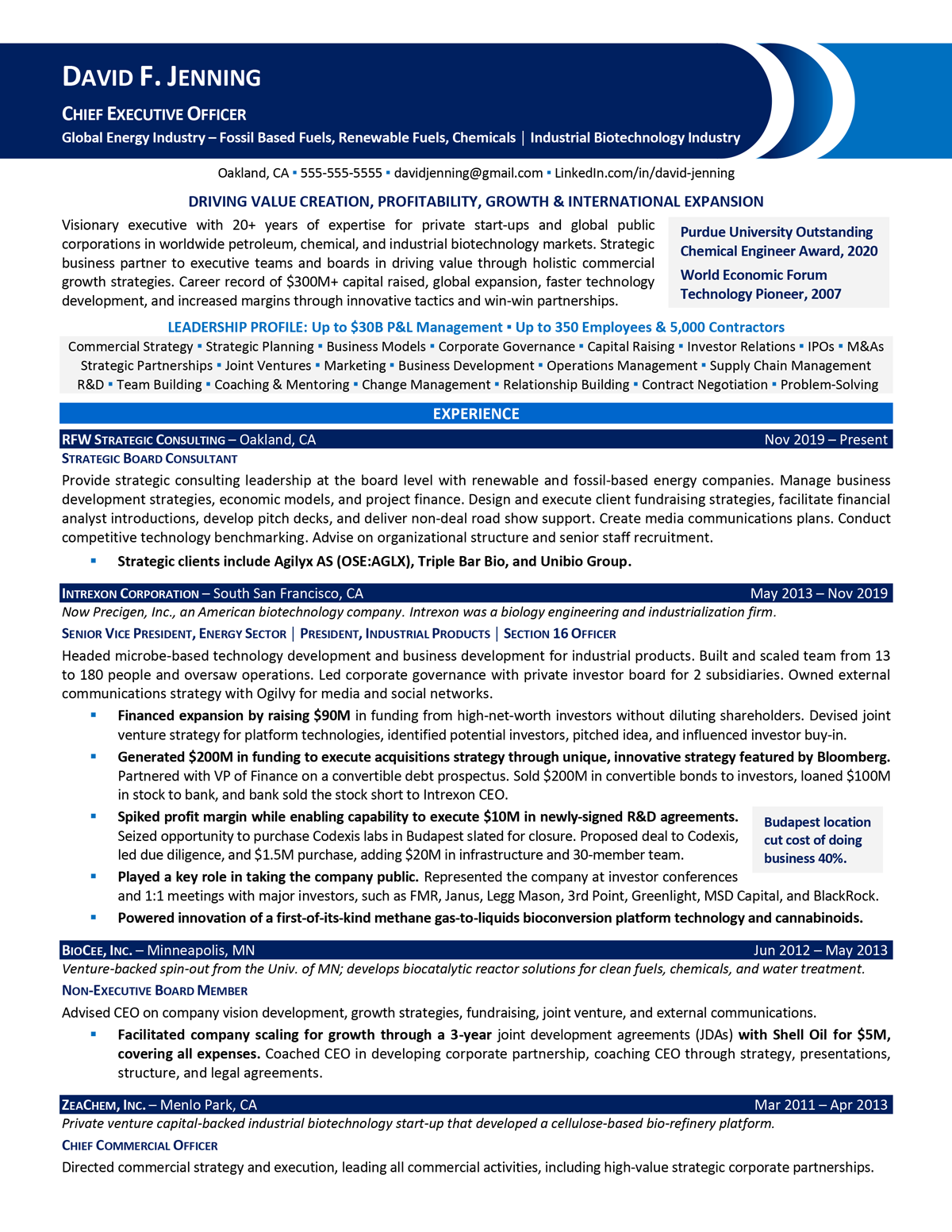
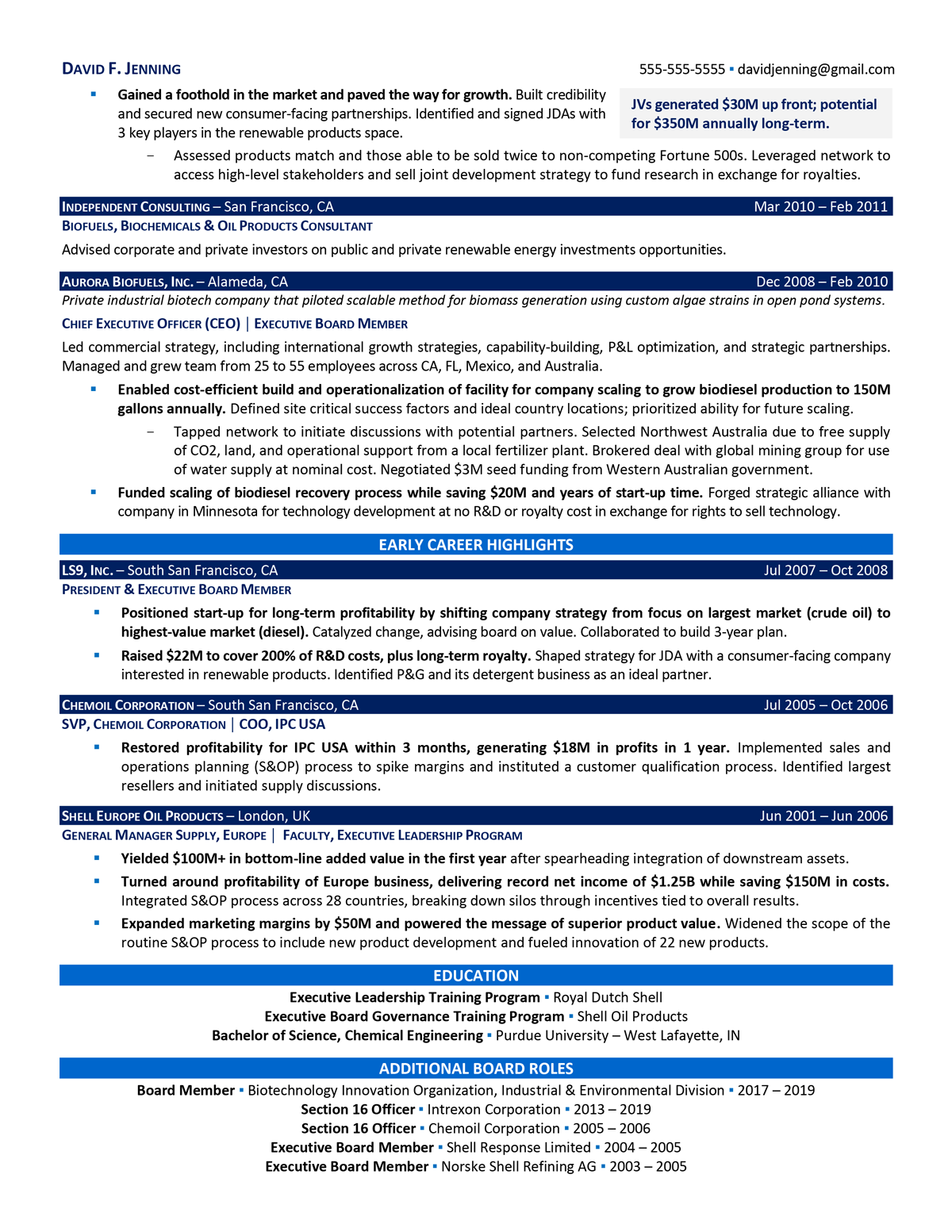
Related Resume Samples:
Request a Consultation from an Award - Winning Recruiter and Resume Writer
(Board C-Level VP, Director & Mid - Career Professionals)
How to write CEO resume
In the corporate world, a Chief Executive Officer (CEO) stands as a beacon of leadership, foresight, and relentless ambition. First things first: Make sure your resume is tailored to the company’s needs. Begin with a brief summary of your career to date.
This means focusing on skills that are relevant to their industry and company. Discuss your skills and abilities in each area of expertise. Include both technical skills and soft skills such as leadership, communication, and teamwork. nclude any awards or recognition that you have received for your work, as well as any other notable achievements (e.g., patents).
A reverse chronological format is most appropriate for a CEO or other position with a high number of years of experience. A reverse chronological resume includes the header with your updated contact details, professional resume summary, work experience, and additional skills and education sections. It should also include your most impressive achievements and honors. Reverse chronological resumes can help you win the approval of Reed Hastings and earn an interview.
Different Sections in CEO Resume are:
- Header
- Summary
- Work Experience
- Skills
- Education
- Additional Section
Industry Stats
According to the U.S. Bureau of Labor Statistics (BLS), the employment of top executives is projected to grow 6% from 2021 to 2031, which is about as fast as the average for all occupations.
Select the Right Resume Format
Choosing the right resume format is crucial to presenting your experience and skills effectively. There are three main resume formats to consider:
- Chronological: This format lists your work experience in reverse chronological order, focusing on your career progression. It is ideal for chief executive officer with a steady career path in the same industry.
- Functional: This format emphasizes your skills and achievements rather than your work history. It can be useful for those with career gaps or transitioning to a chief executive officer role from a different field.
- Hybrid/Combination: This format combines elements of both chronological and functional formats, highlighting relevant skills and achievements while showcasing your work experience. It is suitable for chief executive officer with diverse backgrounds and experiences.
Expert Tip: Make sure you highlight your accomplishments in a way that will appeal to the hiring manager.
CEO Resume Header
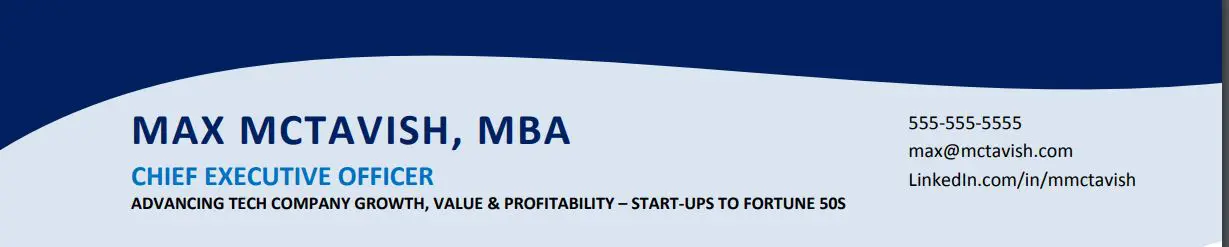
Your resume heading is the first thing that hiring managers see, and it should give them a good idea of who you are. Start your resume with a header that showcase your name, your updated contact details, position and your best skills. It’s also an opportunity for you to set yourself apart from other candidates, so make sure it’s personalized and reflects your professional brand.
Here’s how to create an effective resume header for a CEO:
Your name: Place your full name at the top of the header in a larger, bold font to make it stand out. If you have any relevant professional designations, such as MBA or a specialized certification, you can include it after your name.
Example: Max Mctavish, MBA
Job title or target position: Clearly state your target position, in this case, “CEO” or “Chief Executive Officer,” beneath your name in a slightly smaller font. This helps the hiring manager quickly identify your desired role.
Example: Chief Executive Officer
Contact information: Include your phone number, professional email address and a link to your LinkedIn profile. Make sure your email address is professional, and use a well-known domain, such as Gmail or your own domain.
Example:
555-555-5555
max@mctavish.com
linkedin.com/in/mmctavish
Optional: Mailing address – Including your mailing address used to be standard practice, but it has become less common in recent years. If you want to include it, you can, but it’s not mandatory. In some cases, you may want to include only your city and state if you think your location is relevant to the job.
Example: New York, NY
Professional Tagline – Include a concise and powerful statement that captures your unique value proposition as a leader. It should emphasize your strengths, expertise, and the impact you bring to an organization.
Example: Advancing tech company growth, value & profitability – start-ups to furtune 50s
Formatting: Keep the header clean and simple, using easy-to-read fonts and a consistent layout. Make sure there is enough space around the header so it doesn’t appear cluttered.
Powerful Summary for Chief Executive Officer (CEO) Resume
You must also include a professional career summary. The summary should focus on the specific achievements you’ve made while in each position. A Summary lists your strongest features in a job description for your prospective employer to easily recall and also provides a way to identify personal traits.
Expert Tip: Remember summary sections are brief and contain tiny fragmented sentences.
Chief Executive Officer (CEO) Resume Summary Example
Wrong
Technology and business executive, breaking into new markets globally, and delivering multiple business turnarounds. Versatile, able to strategize the big picture and manage the details. Drove unprecedented growth. Hands-on leader who builds hard-hitting management team and infuses a culture.
Right
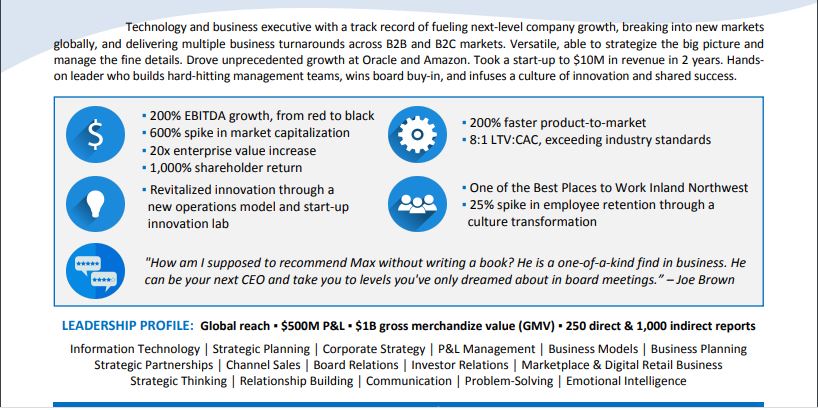
Technology and business executive with a track record of fueling next-level company growth, breaking into new markets globally, and delivering multiple business turnarounds across B2B and B2C markets. Versatile, able to strategize the big picture and manage the fine details. Drove unprecedented growth at Oracle and Amazon. Took a start-up to $10M in revenue in 2 years. Hands-on leader who builds hard-hitting management teams, wins board buy-in, and infuses a culture of innovation and shared success.
You should also include your accomplishments in your summary. Be clear about what you’ve accomplished—and make sure those accomplishments are quantifiable (i.e., number of employees managed, amount of revenue generated). See example of professional summary below:
Chief Marketing Officer Resume Summary Example I
Showcase Your Core Competencies
Below are just some examples of skills required for a remarkable CEO resume. Remember, you cannot just copy and paste these skills into your resume. They must be relevant to you and the job application, and executive skills that you actually possess. You should include all of your hard skills, including certifications and technical proficiencies, as well as any soft skills that are mentioned in the job posting. Each of your key achievement statements can contain these keywords. We use actual examples to demonstrate these skills. Writing a CEO resume is not about “stuffing” executive jargon but providing specific achievement statements that are rich with the relevant keywords.
All Chief Executive Officer Resumes will have different keywords or CEO skills. The executive field is wide and varied. Below are some of the keywords that may relate to you and other CEO professionals, but there are many more specialized keywords that you may need as well.
Expert Tip: By carefully reviewing the job posting and working with an executive resume writer, you can ensure that your CEO resume has the right keywords!
Why are these skills so important to have on your CEO resume?
Because of the dreaded Applicant Tracking Systems used by hiring managers and Executive Recruiters when creating the CEO job description. These ATS systems are programmed with the keywords that the hiring manager feels are most appropriate for their position. These keywords could be slightly different from the exact same job but at a different company created by a different HR manager. It is important to not only match the job title with your branding title but also to match the keywords. A professional CEO resume writer can assist you with keyword optimizing your CEO resume.
Leadership & People Management
- P&L Ownership
- Financial Forecasting
- Budgeting & Resource Allocation
- Financial Reporting Oversight
- Risk Management
- Capital Structuring
- Mergers & Acquisitions
- Profitability Optimization
- ROI Analysis
- Cost Reduction Strategy
- Cash Flow Optimization
- Competitive Market Analysis
- Strategic Partnerships
- Investor Relations
- Long-Term Financial Planning
- Economic Trend Forecasting
- Debt & Equity Management
- Business Modeling
- Scenario Planning
- EBITDA Growth Planning
Business & Financial Strategy
- P&L Ownership
- Financial Forecasting
- Budgeting & Resource Allocation
- Financial Reporting Oversight
- Risk Management
- Capital Structuring
- Mergers & Acquisitions
- Profitability Optimization
- ROI Analysis
- Cost Reduction Strategy
- Cash Flow Optimization
- Competitive Market Analysis
- Strategic Partnerships
- Investor Relations
- Long-Term Financial Planning
- Economic Trend Forecasting
- Debt & Equity Management
- Business Modeling
- Scenario Planning
- EBITDA Growth Planning
Analytical and Technical Skills
- P&L Ownership
- Financial Forecasting
- Budgeting & Resource Allocation
- Financial Reporting Oversight
- Risk Management
- Capital Structuring
- Mergers & Acquisitions
- Profitability Optimization
- ROI Analysis
- Cost Reduction Strategy
- Cash Flow Optimization
- Competitive Market Analysis
- Strategic Partnerships
- Investor Relations
- Long-Term Financial Planning
- Economic Trend Forecasting
- Debt & Equity Management
- Business Modeling
- Scenario Planning
- EBITDA Growth Planning
Tips for CMO resume: Stand out from the crowd
There are a few key things that you can do to make your CEO resume stand out from the rest:
- Tailor your resume to match the requirements of the role
- Use Correct Resume Format
- Write ATS Friendly Resume
- Use Reverse Chronological Format
- Highlight your leadership and management experience
- Make sure your resume doesn't have any spelling or grammar mistakes. Avoid Resume Mistakes
- Create a Targeted Cover Letter
Professional Bio Example I
Professional Bio Example II
Professional Bio Example III
How to write Chief Medical Officer Resume
Industry Stats: According to the U.S. Bureau of Labor Statistics (BLS), the employment of top executives is projected to grow 6% from 2021 to 2031, which is about as fast as the average for all occupations.
Understanding the Role of a Chief Medical Officer
As the highest-ranking medical executive within an organization, the CMO plays a pivotal role in shaping healthcare delivery, ensuring quality patient care, and driving strategic initiatives. Understanding the responsibilities and expectations associated with the role is crucial for tailoring your resume to showcase your suitability. Your resume should outline the core competencies required for a successful CMO, including medical expertise, leadership abilities, strategic thinking, and effective communication skills.
Conducting thorough research into industry trends and insights can further inform your resume-writing strategy, allowing you to align your qualifications with the evolving needs of the healthcare landscape.
A reverse chronological format is most appropriate for a Chief Medical Officer with a high number of years of experience. A reverse chronological resume includes the header with your updated contact details, professional resume summary, work experience, and additional skills and education sections. It should also include your most impressive achievements and honors. Reverse chronological resumes can help you win the approval of Reed Hastings and earn an interview.
Wrong
With a strong background in clinical pharmacology and regulatory affairs, I am confident in my ability to drive strategic initiatives and lead cross-functional teams. My goal is to leverage my expertise in drug development and regulatory compliance to enhance patient care and achieve organizational goals. I am a results-oriented professional with a passion for innovation and a track record of success in the healthcare industry.
Right
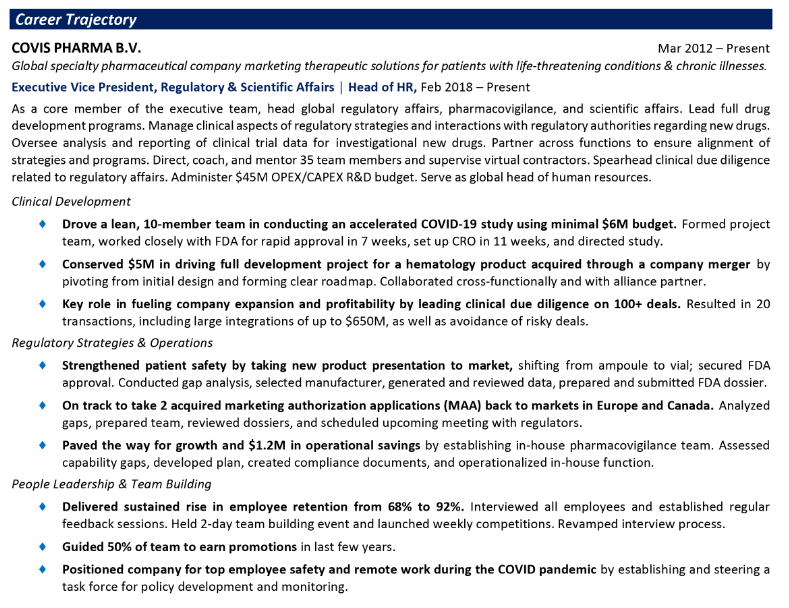
20+ years of expertise in clinical pharmacology and early stage development, powering the strategy, direction, and execution of global and start-up companies’ clinical development plans. Savvy in partnering with stakeholders – played a key role in evolving a start-up specialty pharma company into a global success. Subject matter expert on regulatory affairs. Track record enabling billions of dollars in revenue by securing numerous drug approvals from government regulatory authorities across continents. Data-driven, hands-on leader and team builder with a strong executive presence, empowering and steering 35 cross-functional personnel internationally.
You should also include your accomplishments in your summary. Be clear about what you’ve accomplished—and make sure those accomplishments are quantifiable (i.e., number of employees managed, amount of revenue generated). See example of professional summary below:

Showcase Your Core Competencies
Below are just some examples of skills required for a remarkable Chief Medical Officer resume. Remember, you cannot just copy and paste these skills into your resume. They must be relevant to you and the job application, and executive skills that you actually possess. You should include all of your hard skills, including certifications and technical proficiencies, as well as any soft skills that are mentioned in the job posting. Each of your key achievement statements can contain these keywords. We use actual examples to demonstrate these skills. Writing a Chief Medical Officer resume is not about “stuffing” executive jargon but providing specific achievement statements that are rich with the relevant keywords.
- Medical Leadership
- Strategic Planning
- Healthcare Management
- Clinical Governance
- Quality Improvement
- Patient Safety
- Healthcare Policy Development
- Regulatory Compliance
- Budget Management
- Team Leadership
- Clinical Research
- Health Informatics
- Performance Metrics Analysis
- Risk Management
- Change Management
- Population Health Management
- Telemedicine
- Healthcare Innovation
- Healthcare IT Systems
- Interdisciplinary Collaboration
- Medical Education
- Physician Recruitment
- Public Health Advocacy
- Crisis Management
- Medical Staff Development
- Health Economics
- Continuous Professional Development
- Process Improvement
- Medical Ethics
- Contract Negotiation
- Patient Experience Enhancement
- Hospital Operations Management
- Medical Coding and Billing
- Electronic Health Records (EHR)
- Healthcare Compliance
- Value-Based Care Initiatives
- Healthcare Accreditation
- Health Equity Promotion
- Healthcare Analytics
- Conflict Resolution
- Stakeholder Engagement
- Clinical Pathways Development
- Healthcare Communication
- Medical Legal Issues
- Health Risk Assessment
- Healthcare Financing
- Clinical Decision Support Systems
- Healthcare Marketing
- Population Health Analytics
- Clinical Protocol Development
- Accreditation Standards Knowledge
- Healthcare System Integration
- Patient Advocacy
- Health Information Exchange
- Medical Waste Management
- Healthcare Data Privacy
- Health Technology Assessment
- Clinical Documentation Improvement
- Patient-Centered Care
- Healthcare Vendor Management
- Healthcare Regulation Interpretation
- Hospital Design and Planning
- Healthcare Ethics Committee Participation
- Health Education Program Development
- Medical Equipment Procurement
- Health Policy Analysis
- Healthcare Cost Reduction Strategies
- Healthcare Market Analysis
- Infection Control Procedures
- Incident Reporting and Investigation
- Healthcare Sustainability Initiatives
- Lean Healthcare Principles
- Hospital Emergency Preparedness
- Patient Flow Optimization
- Medical Staff Credentialing
- Healthcare Product Development
- Hospital Accreditation Process
- Medication Safety Programs
- Healthcare Supply Chain Management
- Healthcare Risk Assessment
- Emergency Response Planning
- Healthcare Resource Allocation
- Healthcare Contract Management
- Health Data Security
- Medical Tourism Management
- Healthcare Benchmarking
- Health Information Management
- Healthcare Revenue Cycle Management
- Healthcare Facility Planning
- Healthcare Performance Measurement
- Clinical Training Programs
- Healthcare Fraud Prevention
- Healthcare Strategy Development
- Healthcare Consulting
- Patient Recruitment for Clinical Trials
- Medical Laboratory Management
- Medical Staff Training
- Healthcare Logistics
- Healthcare Regulatory Advocacy
- Healthcare Network Development
Tailor Your Resume to the Target Opportunity
- Analyze the Job Description: Meticulously study the language and key priorities mentioned in the job advertisement. Mirror the keywords in your resume.
- Showcase Relevant Achievements: Highlight the quantifiable results linked with the specific needs of the organization. Did you increase patient satisfaction scores? Enhance operational efficiency? Lead successful quality improvement initiatives? Quantifying your impact is crucial.
Expert Tips for Chief Medical Officer resume: Stand out from the crowd
- Tailor your resume to match the requirements of the role
- Use Correct Resume Format
- Write ATS Friendly Resume
- Use Reverse Chronological Format
- Highlight your leadership and management experience
- Make sure your resume doesn't have any spelling or grammar mistakes. Avoid Resume Mistakes
- Create a Targeted Cover Letter

